
半泽直树
国内新租赁经济报告:存款冲突,信用豁免将取代_我的网站

一 |
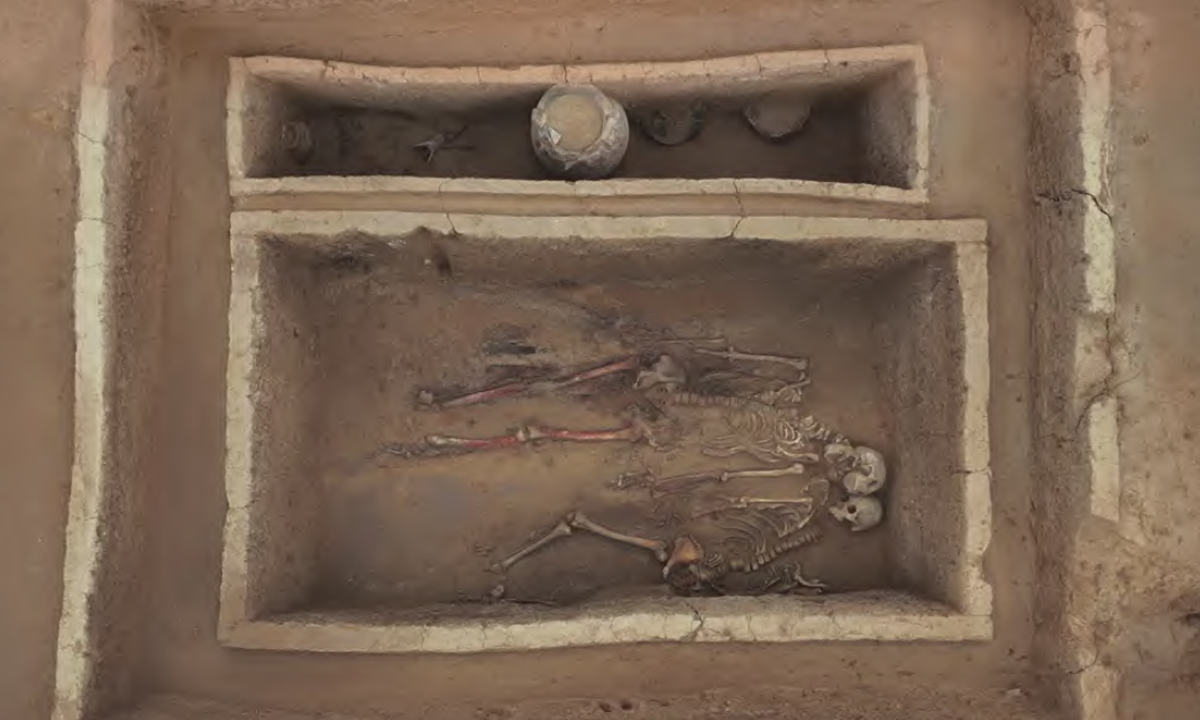
Located on a hilly terrace west of the Taihang Mountains and flanked by the Songxi River, the site was excavated in 2024 and 2025 by the Shanxi Provincial Institute of Archaeology and partner institutions, leading to the discovery of 18 tombs, including six Xia Dynasty burial sites and 12 Warring States Period (475BC-221BC) graves.
"These are the highest-ranking Xia aristocratic tombs discovered so far, indicating that this location was a regional center," the institute said.
The Xia Dynasty is traditionally regarded as China's first hereditary dynasty, though contemporaneous written records are lacking.
The well-organized Xia tombs, concentrated in the western part of the cemetery, feature uniform east-west oriented vertical earthen pits. Researchers recovered nearly 40 sets of artifacts with distinctive local cultural characteristics, including pottery, lacquerware and turquoise ornaments.
Extended regional surveys across the Songxi River valley yielded more than 10 Xia and Shang period sites. Test excavations at nearby relic sites unearthed pottery fragments, stone tools, bronze knives, as well as tin-bronze ingots and smelting residue, providing solid evidence of early metal mining and craftsmanship.
Local copper-iron symbiotic ore deposits confirm exploitation of these resources during the Xia and Shang eras, while typical cultural artifacts found in adjacent counties reveal widespread regional cultural exchange.
Multidisciplinary analyses further decoded the civilization's features. Ancient human remains belong primarily to the ancient population of the Central Plains with minor Mongolian Plateau genetic traits, forming a stable patrilineal clan. The community relied on millet farming and maintained long-distance resource trade networks.
Artifact provenance tests trace scallop shell ornaments to the Bohai Sea, cinnabar to Hunan-Guizhou ore belts, turquoise to the eastern Qinling Mountains area, and coffin timber to local Taihang pine trees. Such diverse materials reflect close interaction among the Taihang foothills, the press release noted.
Lab restoration unveiled refined ritual relics, including a dragon-patterned lacquer cylinder with red and black stripes and an intact lacquer gu vessel (a type of wine vessel). Turquoise plaques from the site match specimens from the Erlitou site, a core Xia cultural relic, proving cross-regional cultural interaction. Radiocarbon dating places the site's active period between 1880BC and 1450BC, aligning with the late Xia Dynasty.
Scholars confirmed the findings have helped reshape academic understanding of Xia-Shang civilizations and reconstruct multi-level settlement patterns on the western Taihang foothills, while offering new insights into social complexity and civilization development in early China.
。1月15日,中国第一份“2019年新租赁经济报告”今天发布。报告指出,明年中国的租赁经济预计将超过10万亿元,参与租赁经济服务的人数将超过1亿。报告指出,近年来,在经历了“野蛮增长”和无序竞争之后,以存款为主要盈利模式的“伪共享经济”失去了活力,一些自行车企业破产,数千万用户的存款难以收回。据调查,自去年以来,用户对存款模式一直很抵触,这种模式已经开始失去市场。经过多次存款风暴,芝麻信用豁免模式已成为一种新的主流趋势。目前,用户可以在数百种业务场景中获得免信用服务。

二 | 据报道,芝麻信用的目标是消除“存款”,以彻底缓解消费者对金融安全的担忧。有关官员透露,截至年底,芝麻街信用已累计为用户提供超过1000亿元的无抵押贷款。据研究开发,自去年以来,无抵押租赁市场有三大趋势:一是三、四线城市的崛起,用户的快速增长,占总用户的近30%;二是年轻化趋势明显,80、90岁后占总用户的90%以上。此外,2018年,用户租赁的商品更为丰富,3C数码、服装配件、书籍成为最常用的物品。

三 | 商品、个人物品可以免收的押金金额也在不断增加。但是,实施免信服务的企业由于用户数量的快速增长,没有出现明显的资金损失,甚至更快地进入盈亏平衡期。芝麻信用数据显示,在手机、3C数码、服装、收费宝等领域,大部分商品的违约率在免存后下降了一半,新增用户增长了60%以上。如今,从衣服到电脑、玩具和婴儿车,都可以出租。无论是高频日用品还是高价值数码奢侈品,都可以通过租赁获得使用权,这已成为年轻人追求优质生活的新途径。关于新租赁经济的未来前景,据报道,2018年,中国租赁经济市场成交额将超过6.3万亿元,预计到明年将超过10万亿元,参与租赁经济的服务商数量将超过1亿人。
Current article:http://www.liangkuataosanxuanmiancen.sbs/eud/h33e.pptx
Published on:01:10:23