

个人简介
新警察故事


推荐博文
匹诺曹
2026-08-26
分类: 智联招聘
匹诺曹
Eight major polysilicon producers in China pledge to avoid below-cost sales amid ‘anti-involution’ push_我的网站

A |
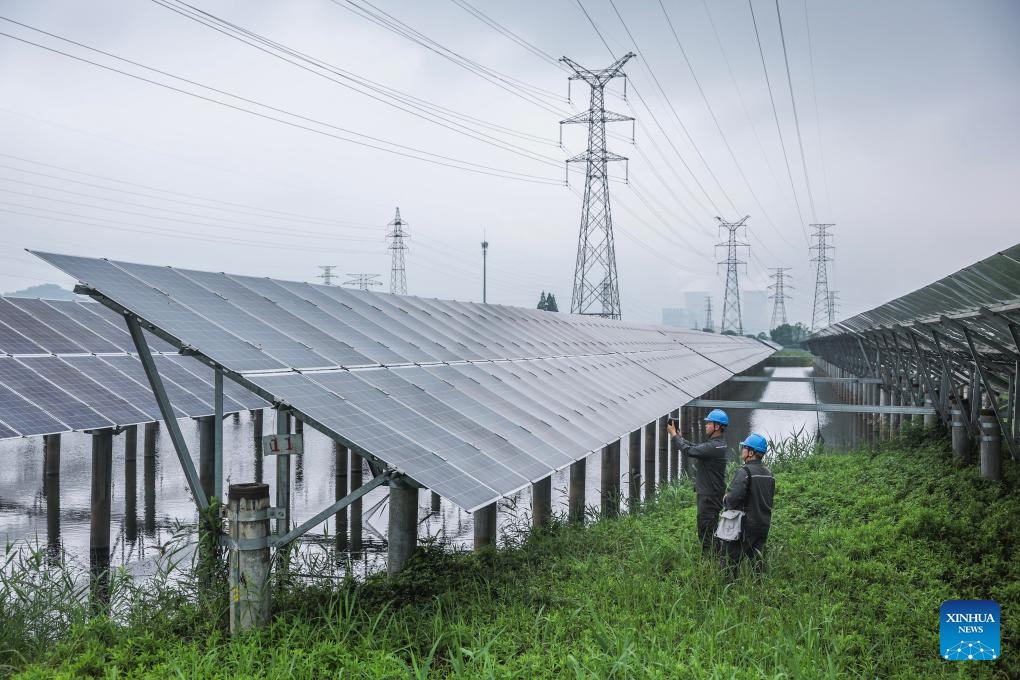
Eight Chinese leading polysilicon producers have issued public pledges to stop selling solar products below a cost benchmark, in a fresh industry effort to curb "involution-style" competition and support healthier pricing in the country's photovoltaic supply chain, the Shanghai Securities Journal reported on Friday.
Industry experts said that this move will not only help stabilize profits across the sector, but also promote the Chinese photovoltaics (PV) industry's shift toward high-quality development.
The eight companies jointly committed that the selling prices of all photovoltaic products, including tender bids, must not fall below the corresponding cost calculated under the group standard General Principles for Cost Accounting Models in the Photovoltaic Industry. Any sales below full cost must be "immediately stopped and corrected," according to the report.
The pledge was signed in Shanghai on Thursday by the companies, including four listed companies — Tongwei Solar Co, GCL Technology Holdings Limited, Daqo New Energy Co, Xinte Energy Co. The other four companies are Asia Silicon (Qinghai) Co, Xinjiang East Hope New Energy Co, Qinghai Lihao Qingneng Co, and Xinjiang Goens Energy Technology Co.
Together, the eight companies account for more than 90 percent of China's effective polysilicon production capacity, the Shanghai Securities Journal report said.
Under the initiative, the companies also agreed to accept supervision and inspections from market regulators at all levels and to strengthen mutual oversight. If they discover illegal below-cost sales, they are required to report the issue and file complaints with the industry association and the State Administration for Market Regulation (SAMR).
In addition, the firms committed to strictly implementing China's new energy-consumption standards and to proactively eliminate outdated, high-energy-consuming production capacity.
The move comes just one week after the SAMR held a solar industry price-compliance meeting on July 31, urging solar PV companies to strengthen price compliance and shift competition from price to quality.
It instructed companies to strengthen cost accounting, establish and improve price compliance systems, and carry out comprehensive self-inspections and corrective actions, according to the Xinhua News Agency.
Industry experts welcomed the initiative, saying that years of excessive competition have pushed many photovoltaic firms into losses, which is harmful to the industry's long-term development.
China's PV industry is mired in severe low-price competition, with profit margins squeezed along the entire value chain and many firms operating at a loss, Xiang Ligang, director-general of the Zhongguancun Modern Information Consumer Application Industry Technology Alliance, told the Global Times on Friday.
Xiang added that the initiative could help ensure more reasonable revenue and profit levels, which are essential for sustainable industrial development. The move also reflects a broader shift among Chinese firms toward greater coordination in responding to market pressures.
Although the industry also faces external challenges, including US tariffs on polysilicon-related products, Xiang said the main purpose of the initiative is to improve the sector's own development model rather than simply respond to foreign trade measures.
China has launched sweeping efforts to curb "involution-style" low-price competition and accelerate the phase-out of outdated industrial capacity. China's Ministry of Industry and Information Technology on July 3 held a symposium for manufacturing enterprises, focusing on accelerating the high-quality development of the photovoltaics industry, according to the Xinhua News Agency.
The symposium called for efforts to comprehensively deal with the problem of disorderly price competition in the photovoltaics industry in accordance with laws and regulations, as well as efforts to guide enterprises to improve product quality, phase out backward production capacities in an orderly manner and achieve healthy and sustainable development, Xinhua reported.
。

B | 1月16日,三星将于2月20日推出Galaxy S10系列,包括Galaxy S10、Galaxy S10 Plus和Galaxy S10 E(以前称为S10 Lite)。上周,GalaxyS10E以855和6GB的内存出现在Geekbench上。今天,Galaxy S10在Geekbench上运行。数据表明,Galaxy S10还搭载了一款6GB内存的Paragon 855处理器,在单核和多核测试中分别达到3413和10256点。这些分数与最近出现在Geekbench上的其他Paragon855设备的分数基本相同。有传言说,这台机器也有一个8 GB的RAM版本,这预计将提供更好的性能比6 GB的RAM版本。根据先前的报道,三星Galaxy S10将配备6.4英寸S-AMOLED显示屏、屏幕穿孔设计、两个前置摄像头、一个内置3500 mAh电池、一个三摄像头后置以及最大512 GB的存储空间。
Current article:http://www.liangkuataosanxuanmiancen.sbs/jl52p9k/20260826/837310.docx
Published on:20:08:46
相关热门文章
- PM launches single brand ‘Bharat’ for subsidised fertilisers
- Philippines says its coast guard ship and supply boat are hit by Chinese vessels near disputed shoal
- 专栏作者质疑哈登续约:37岁老将合同恐成隐患
- 与智能语音助手一起骑自行车。一些公司说它可以帮你点外卖。
- 临平“数实融合”如何差异化突围?


